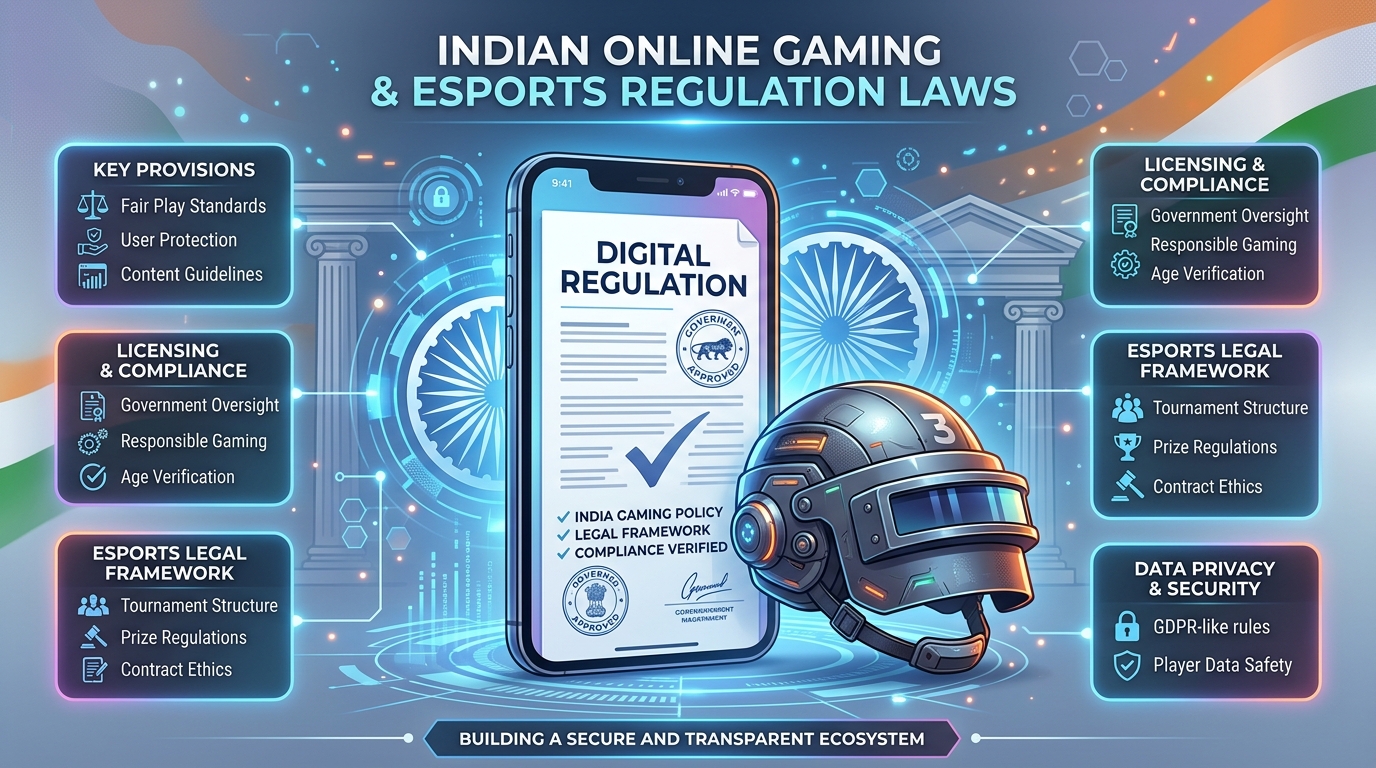
India's online gaming and esports scene has experienced astronomical growth. With over 500 million active gamers, India is now the world's largest mobile gaming market. To manage this massive space, protect players, and weed out illegal gambling operations, the Government of India has established comprehensive regulatory frameworks.
However, reading legal notifications can be challenging. In this guide, we break down the **IT Amendment Rules 2023**, the legal difference between **Games of Skill** and **Games of Chance**, and how **Esports** is officially classified in India — written in a simple, easy-to-understand way.
1. MeitY IT Intermediary Rules: The Foundation
On April 6, 2023, the **Ministry of Electronics and Information Technology (MeitY)** notified amendments to the *Information Technology (Intermediary Guidelines and Digital Media Ethics Code) Rules, 2021*. These rules created a formal federal structure to govern online gaming.
Key provisions include:
- Permissible Online Games: The regulations permit real-money online games that do not involve wagering, betting, or gambling on outcomes.
- Grievance Redressal: Online gaming platforms must appoint a resident Chief Compliance Officer, a nodal contact person, and a dedicated Grievance Officer based in India to resolve user complaints.
- Mandatory KYC Verification: Under the guidelines, real-money gaming platforms must conduct strict user identification verification (Know Your Customer or KYC) before accepting deposits or initiating cash prize withdrawals.
2. Game of Skill vs. Game of Chance: The Legal Line
Under Indian law, online gaming is strictly categorized into two columns. This distinction determines whether a platform is legal or illegal:
- Game of Skill (Permissible): A game where the outcome is predominantly determined by the player's knowledge, training, experience, reaction time, and strategical thinking. Examples include chess, fantasy sports, and tactical shooter tournaments (like BGMI). The Supreme Court of India has consistently held that games of skill are protected under Article 19(1)(g) of the Indian Constitution as a legitimate business.
- Game of Chance (Restricted/Gambling): A game where the outcome is decided purely by luck or random elements (like dice, card shuffling, or roulette). Platforms offering real-money wagering on games of chance are classified as betting/gambling and are prohibited in most Indian states.
3. Official Recognition of Esports in India
One of the most significant milestones for the gaming community was the official recognition of Esports as a sport. In December 2022, the Government of India amended the **Allocation of Business Rules**. The President of India directed that **Esports be included under the Ministry of Youth Affairs and Sports (MYAS)** as a category of "Multisport Events."
Why this matters: This recognition formally separates "Esports" (competitive, professional video gaming) from general online card games or real-money casual gaming, opening doors for government recognition, official athletic status, and national team representations at events like the Asian Games.
4. Compliance Checklist for Indian Gamers
To play safely and ensure you remain compliant with Indian regulation:
- Verify Age Restrictions: Standard cash-prize tournaments on skill-based platforms are strictly limited to users **18 years or older**.
- Check Geographic Eligibility: Certain Indian states (such as Assam, Odisha, Telangana, Nagaland, Sikkim, Andhra Pradesh, and Tamil Nadu) have specific regional gaming restrictions. Cash play is typically blocked in these locations.
- Submit Real PAN/Aadhaar: Compliance KYC rules require submitting matching credentials to verify identity and file TDS reports under Section 194BA.
References and Official Sources
To provide transparency, here are the official government resources and policy links:
- MeitY IT Amendment Rules 2023: Official Gazette Notification on Intermediary Guidelines for Online Gaming. Read Official PDF Notification (MeitY) .
- Esports Recognition under MYAS: Cabinet Secretariat Amendment Notification incorporating Esports under Multisport Events (Ministry of Youth Affairs and Sports). Read Business Allocation Amendment (Government of India) .
- Supreme Court Precedents on Game of Skill: Landmark judgments defining the legal protections for games of skill under Indian constitutional rights. Reference Case Law: State of Andhra Pradesh v. K. Satyanarayana (1968) and K.R. Lakshmanan v. State of Tamil Nadu (1996).
At Virtual Esports, competitive integrity and regulatory compliance are our highest priorities. Our tournament lobby automation, AI OCR results audits, and strict KYC flows align 100% with the MeitY Intermediary Guidelines, providing Indian gamers a legal, secure, and government-compliant environment to compete and earn.